

Everything for Everyone
The Commons Way Of Life We Were Taught to Forget

The default setting
If two young children meet outside in a playground, and one of them has a ball, it wont be long before they are passing it to each other. Then, if a third child comes along, within minutes they’ve invented a new game, which is improvised and adjusted as they go. Humans are naturally creative and collaborative like this. These are some of the oldest human instincts.
For most of human existence, not just the last few centuries of recorded history we tend to fixate on, but the hundreds of thousands of years humanity has been around, people lived in ways that look, to us in our modern world, as almost unrecognisable. Anthropologists and archaeologists have discovered that we often organised ourselves, in the similar cooperative ways that children do, even at a larger scale.
This wasn’t because we were less intelligent (we weren’t, survival took more intelligence back then), nor was it because life was brutal and short (that’s a story told much later, by people with something to gain from it). But because the basic organising principle of daily life wasn’t ownership of things, and earning a living by working for someone else.
Back then you worked as much land as you could work in a day1, without paying someone else to do it. You took from the forest what you needed, and didn’t take any more to sell it. You grazed your animals where there was grass, which was usually on land you all shared. And so did everyone else, not in competition, but alongside each other, within a web of informal agreements that everyone understood because everyone had grown up inside them.
There was no deed. No title. No fence (and when those were invented it was to keep wild animals – not people – out). The relationship between a person and the land they worked was immediate and practical: you had an immediate temporary claim on it because you were using it, and your claim lapsed when you weren’t. Anthropologists call this ‘usufruct’, the right to benefit from something you don’t own, though the people living this way wouldn’t have needed a word for it, any more than fish need a word for water.
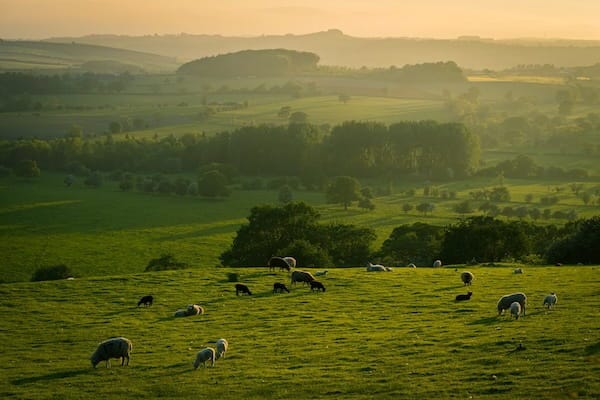
The historian James C. Scott, drawing on archaeological and anthropological evidence across multiple continents, showed that early human communities were far more mobile, flexible, and resistant to fixed hierarchy than we tend to assume. Hunter-gatherer bands moved seasonally, following resources rather than claiming them. When things got scarce, they moved on. When they returned, the land had recovered. This wasn’t accident. It was a practice developed, transmitted, and refined across generations. It was called the commons.
‘Ours’ before ‘mine’
The commons begins, as most things do, with family. Think about how resources move within a household. Nobody invoices their partner for cooking dinner. Nobody charges their child for the use of a bedroom. There’s no market inside a family, because the relationships are organised around need and reciprocity rather than transaction. What’s mine is available to you, what’s yours is available to me, and we’re both better off for it.
This logic extended outward, to neighbours, to the village, to the wider community, for most of human history. The commons wasn’t a formal institution imposed from above, it was the natural shape that cooperation takes when people live closely together and depend on the same land.
Scholars used to assume, following Adam Smith, that before money there was barter, that people traded wheat for shoes and meat for pots in a primitive version of the marketplace. The anthropologist David Graeber spent years looking for ancient evidence of this barter economy and couldn’t find any. No society has ever been documented that organised itself primarily through the exchange of goods between individuals. What actually existed, everywhere, were systems of mutual obligation, gift, and reciprocal support. The shoemaker didn’t trade shoes for wheat, the community fed the shoemaker, and the shoemaker kept everyone’s feet dry. Debts were social rather than financial. Memory and relationship did the work that money later claimed to do.
This matters because the standard story, that markets are natural and ownership is instinctive and competition is the default, is not history. It’s a story told backwards, projecting the assumptions of the present onto a past that worked very differently.
How the commons worked
In medieval England, most of the land was managed as commons. Villagers held strips of arable land for their own crops, but the woodlands, meadows, and pastures surrounding the village were shared. These weren’t free-for-alls. They were governed by detailed, locally negotiated rules about how many animals each family could graze, when different areas could be used, and how much timber could be taken and for what purpose.
The rights had names: pasture (grazing), estovers (collecting wood for fuel and repairs)2, piscary (fishing), pannage (letting pigs forage in woodland), and turbary (cutting peat). These were customary entitlements, handed down and understood, later enforced by the community through the manorial courts. If someone overgrazed their allocation, neighbours would say so. Social pressure, reputation, and long memory were the mechanisms of governance.
Elinor Ostrom, who won the Nobel Prize in Economics in 2009 for her research on exactly this question, documented hundreds of commons systems across the world that functioned for generations without collapse: Swiss alpine pastures managed collectively since the sixteenth century, irrigation systems in Spain and Japan organised through village assemblies, fishing communities in Maine that developed their own informal territorial rules without any government involvement. Her conclusion, backed by decades of careful fieldwork, was that communities managing shared resources are perfectly capable of doing so without collapsing into conflict or depletion, provided they can make their own rules, monitor compliance themselves, and adapt as conditions change.
None of this required a state. None of it required a market. It required trust, communication, and a shared stake in the outcome.
There’s a theory, popular since the 1960s, called the ‘tragedy of the commons’. It claims that any shared resource will inevitably be overexploited, because each individual has an incentive to take more than their share before anyone else does. It’s taught in economics departments and cited to justify privatisation. As a description of how actual commons worked, it is also wrong. The economist Garrett Hardin, who coined the phrase, wasn’t describing a commons at all. He was describing an open-access resource with no rules and no community. Real commons had both. The tragedy he described was the tragedy of the market, not the commons.
Rights and obligations
In a commons, rights and obligations come as a pair. You can’t pull them apart. The right to graze your animals on the common pasture came with the obligation not to overgraze. The right to collect firewood came with the understanding that you wouldn’t strip a hillside bare. The right to fish the local stream came with the expectation that you’d leave enough to breed. These weren’t constraints imposed on freedom from outside, they were the conditions that made the freedom possible in the first place.
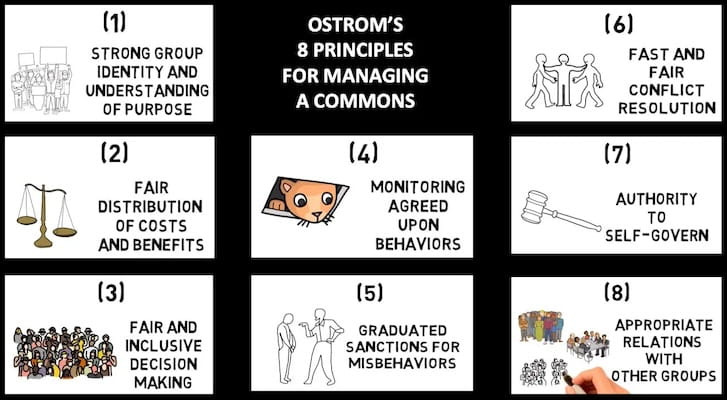
This is very different from how we talk about rights today, where the emphasis falls entirely on individual entitlement: what I am owed, what I can do, and what cannot be taken from me. The commons tradition held that rights were relational. They existed in the space between people, and they only worked because everyone was bound by the same obligations to everyone else.
The Franciscan theologians had a phrase for this: juri divino omni sunt communia, by divine law, all things are held in common. The argument wasn’t sentimental but structural: the earth is not anyone’s to own absolutely, and we are all of us tenants here, with obligations to each other and to what comes after us. According to the biblical book of Acts, this was the way the early Christians lived. However, you don’t have to share the theology to recognise the logic.
The commons is not just land
It’s tempting to think of the commons as a historical land arrangement belonging to a pre-industrial world that has no bearing on ours. But the commons is a practice before it’s a place, and that practice turns up wherever people choose to share rather than compete.
Consider the seeds that farmers have saved and exchanged for ten thousand years, the accumulated knowledge of what grows where, encoded in the varieties themselves, passed from hand to hand across generations. Or the folk songs or fairy tales that nobody owns. Or the mathematical theorems that belong to everyone who understands them.
Commons can be the common practice, or even an act of rebellion. Consider Sci-Hub. In 2011, a Kazakhstani graduate student named Alexandra Elbakyan set up a website that made tens of millions of academic papers freely available to anyone who wanted them. Much of this is publicly funded scientific and medical research — work that could benefit any of us, paid for by our taxes — produced by researchers, peer-reviewed by other researchers (usually for free), then locked behind journal paywalls that charged universities (including those which did the research) hundreds of millions of pounds a year for access, and individuals up to £30/$40 for a single article. Sci-Hub removed the paywall. By 2025 it had indexed over eighty-five million papers. It is the largest library of scientific knowledge in human history, and it exists because one person decided that knowledge is a commons and acted accordingly, without asking permission.
The commons is anywhere that people create or maintain something together, without privatising the result. It’s the pub where regulars know each other’s names and someone gets a round in. It’s the allotment where people swap surplus vegetables over the fence. It’s the mutual aid group that organised food deliveries during the Covid lockdown. It’s the community workshop where anyone can use the lathe or the maker shop where they share the 3D printer.
Why the commons threatens power
The commons didn’t become obsolete. It wasn’t replaced because we found a better way. The commons had to be destroyed rather than simply outgrown, and there’s a reason for that.
A community that feeds itself from shared land does not need an employer. A community that maintains its own water supply does not need a water company. A community that shares knowledge freely does not need to buy it. Wherever it exists, the commons reduces dependence on the market and on the state, and dependence is the mechanism through which both extract their power.
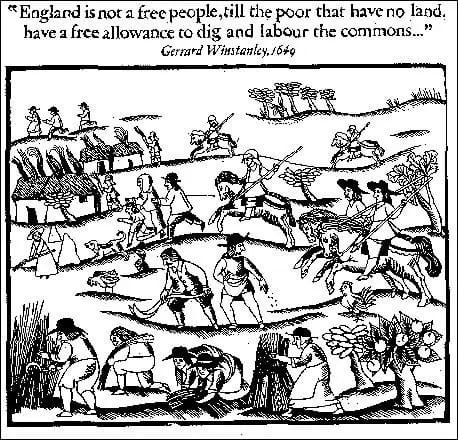
Dominance hierarchies, whether political or economic, require that the people below them have limited alternatives. A worker who could survive without wages has leverage. A tenant who could house themselves without a landlord has power. A community that can meet its own needs without the mediation of capital or state is, from the perspective of capital and the state, a problem.
The commons also does something more subtle and perhaps more threatening: it demonstrates, in practice, that people can organise their own affairs. Every Swiss alpine community that has managed its pastures for five centuries is evidence against the claim that human beings are too selfish or too chaotic to cooperate without authority over them. Every Wikipedia article is evidence against the claim that people won’t contribute without payment. The commons doesn’t just provide resources, it provides proof that a better way is possible.
Commoning as prefiguration
There’s a word in radical politics for the practice of building the world you want to live in rather than waiting for permission to do so: prefiguration. The idea is that you plant the seeds of a better world within the one you already inhabit, and tend them through community, rather than trying to overthrow the competitive world head-on. The means and the ends have to match. You can’t build a free society through authoritarian methods, any more than you can poison the water upstream of your enemies without poisoning yourself downstream.
The commons is prefiguration in its oldest form. Long before anyone coined a political theory of it, communities were organising themselves without bosses, distributing resources without markets, resolving disputes without courts. This wasn’t an experiment, but ordinary life. The commons didn’t prove that a better world was possible. It proved that one already existed, in fragments and patches, everywhere people chose to put their shared life ahead of their individual advantage.
Contemporary commons are doing the same thing. The free software licences that prevent code being enclosed by corporations, the community land trusts that take housing out of the property market, the cooperatives that give workers control of their workplace, the Mondragon cooperatives in the Basque Country that have sustained over eighty thousand worker-owners across interconnected businesses since the 1950s. They’re not arguing for an alternative. They’re building one.
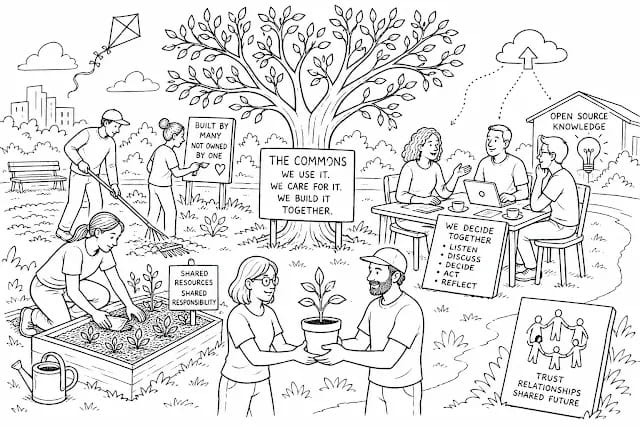
There’s a Zapatista phrase, preguntando caminamos, ‘asking questions, we walk’. You don’t need to know where you’re going before you set off. The path is made by walking it, and the questions you ask along the way are part of how you find your footing. The commons doesn’t offer a blueprint, it offers a practice.
It asks what it would mean to manage this resource together, to make these decisions in common, to hold this thing for everyone rather than extracting value from it for a few. And then it gets on with doing that, while the argument about whether it’s possible continues somewhere else.
What we already know
We already know how to do this. We’ve always known. Every time you share without keeping score, every time a community decides something together, every time knowledge is passed on freely, every time a resource is managed with future generations in mind, the commons is happening. It isn’t a foreign idea imported from theory. It’s what people do when nobody is forcing them to do otherwise.
The commons is the default. What replaced it took violence, law, and centuries of effort to install. For most of human history, most people most of the time understood that the earth was something you belonged to, not something you owned. The land fed you because you tended it, and you tended it because it fed you, and the same was true for everyone around you. That’s not nostalgia. It’s most of human history.
The children in the playground didn’t need to be taught how to share. They had to be taught not to.
The kingdoms of the world are yours
each heart self-governed
the vast family of love
raised from the common earth
by common toil
enjoy the equal produce
– Samuel Taylor ColeridgeBibliography
David Graeber & David Wengrow, The Dawn of Everything, 2021.
James C. Scott, Against the Grain, 2017.
Massimo De Angelis, Omnia Sunt Communia, 2017.
David Bollier, Think Like a Commoner, 2014.
David Graeber, Debt: The First 5,000 Years, 2011.
James C. Scott, The Art of Not Being Governed, 2009.
Peter Linebaugh, The Magna Carta Manifesto, 2008.
Christopher Boehm, Hierarchy in the Forest, 1999.
J.M. Neeson, Commoners, 1993
E.P. Thompson, Customs in Common, 1991.
Elinor Ostrom, Governing the Commons, 1990.
Marshall Sahlins, Stone Age Economics, 1972.
Karl Polanyi, The Great Transformation, 1944.
Peter Kropotkin, Mutual Aid, 1902.
An ‘oxgang’ was the amount of land one ox could plough in a year. A ‘virgate’ was roughly 30 acres, considered enough to support a family. These measurements varied by region based on soil quality and terrain
Each of these woodland rights (‘estovers’) had their own terms:
Rights to gather wood for fuel (firebote)
Rights to collect timber for building repairs (housebote)
Rights to gather material for tools (ploughbote)
"It's what people do when no one's forcing them to do otherwise."
This is the line I most want to borrow. IT says so much.
Based on just the headline: immediately yes! Will read later today.